You can do better

I’m really happy there is finally some representation of ethnic families with sitcoms like ABC’s “Blackish” and “Cristela.” Most weeks Blackish makes me laugh until I cry. Culturally, though, I relate most to Cristela.

While I don’t find Cristela’s mom’s character entirely believable as a first-generation American, I can appreciate the lessons she teaches.

Tonight’s episode especially hit home with me.

natalia

ABC’s Cristela’s mom Natalia (Terri Hoyos) defends a difficult parenting decision. (Source: Cristela FB page)

In this episode, Cristela’s mom, Natalia, reveals she had not entered Cristela, now a 20- or 30-something legal intern, into the gifted and talented program when she was a little girl because “people like us” didn’t belong in “fancy programs” like that. Basically, they would have been aiming too high, beyond their social status.

Cristela’s character eventually comes to appreciate her mother’s decision, made out of the desire to protect her. Natalia was, after all, a single mom doing the best she could for her young family.

This struggle triggered something in me I totally didn’t expect – a belated appreciation for my mom’s determination to ensure my best possible future.

It actually set off my tear ducts.

[Cue high school memory scene.]

One time, in high school, I came home with less-than-perfect grades – mostly As, with a couple of A- and a B+. I was so excited to show my mom! She would be so proud.

“You can do better.” That was her response.

What??? I can do what??? You mean, that wasn’t good enough?

I carried this disbelief, the shock and the sense that I’d disappointed my mom for – well, let’s just say it went on far too long.

What I didn’t realize then that I realize now – and, truly, especially after watching Cristela tonight – was that my mom was pushing me to aim higher.

Nothing at all wrong with protecting one’s kids from ridicule and humiliation. My mom, however, was willing to take that risk – taking me with her – of not being accepted for being different (which, by this age, I was pretty good at).

As someone who had to leave school at 12 to work and support her family, she knew working harder would grow both my character and my capacity. She knew I could do better.

My mom has never done anything less than teach me to be strong, have faith and, in the face of difficulty, get back up and dust myself off.

As we approach in a few weeks what would have been my parents’ 60th anniversary, I can’t help but be grateful for her strength and endurance since losing my dad nearly 30 years ago.

She remains my best girlfriend and biggest cheerleader. Even today, the way she lives her life is a reminder that we can always do better. So I will.

When the fog clears, you can see forever

golden-gate-bridge-fog

I miss our frequent visits to the Bay Area for conferences. I seriously could stare at this view. All. Day. Long. (Image: Axel Anta)

Or at least, what lies just ahead.

Work (or anything, really) can be like a fog, occupying our minds and keeping our lives busy, too full to accommodate one more idea or commitment. Certainly no room for dreaming.

After months on a fairly sizable freelance project, I’m taking off for a few weeks.

On this first day off, there was no pile of work to plow through. No emails to answer or meetings to attend.

Free to think, breathe and generally just chill, I found clarity like I hadn’t had in sometime. Oh, the peace.

Jeremiah 29:11

The forest or the trees?

Forest or the trees?

Good days are like that.

They can start out feeling like you can’t see the forest for the trees, and then – all of a sudden, the path is straight. Before long, you’re in a clearing and, while the destination is a long way off, with new clarity, you know exactly where you’re going.

Just keep your head down and keep paddling. You’ll get there.

And the winners are…

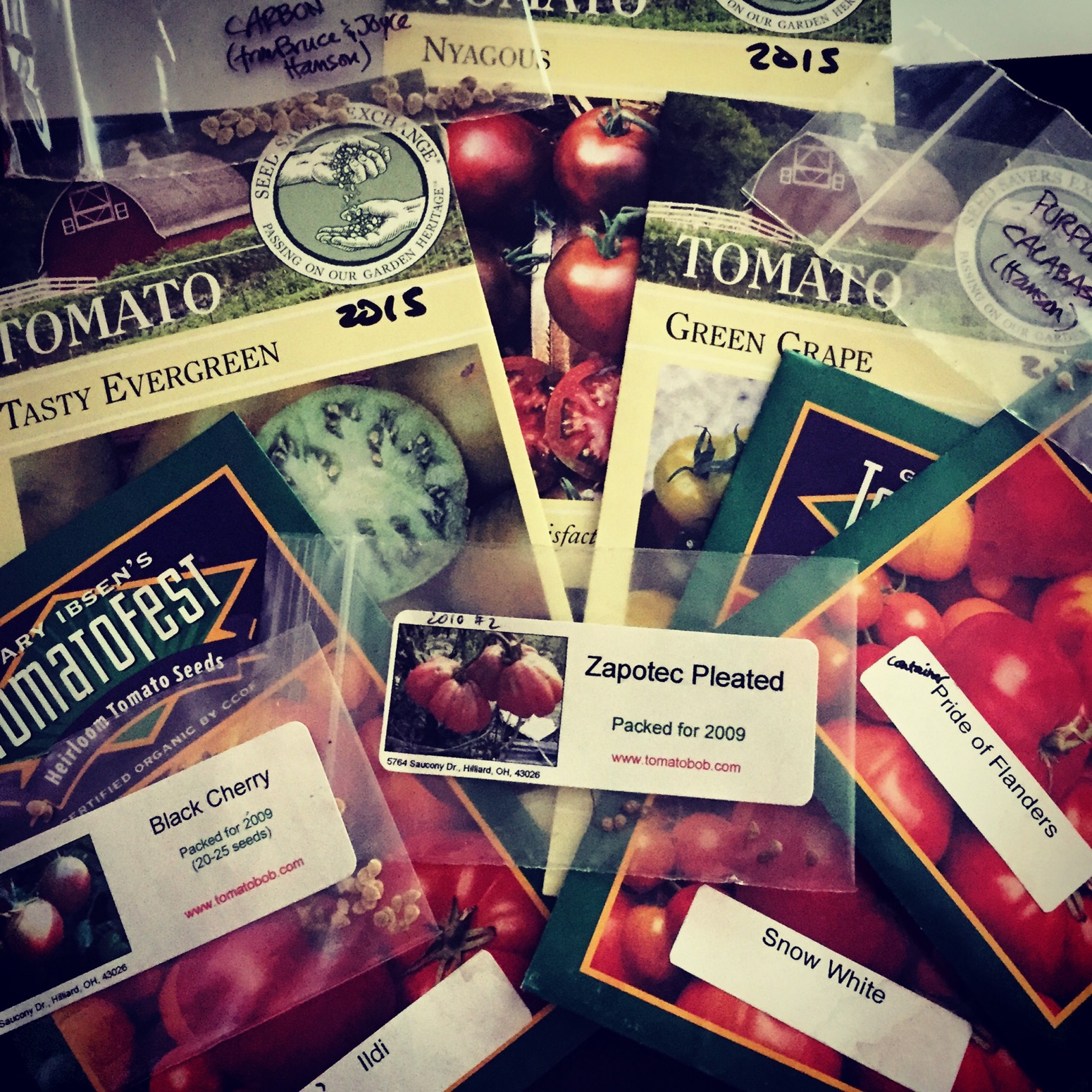
Heirloom tomatoes for 2015 planting

Every year, it feels like a crapshoot. And every year, we’re amazed at the bounty and beauty that comes from the earth.

Eight to 10 heirloom tomato varieties (plus tomatillos!) varying in size, shape and color. Salad forecast for 2015: pretty darned good.

Writing about what hurts

Writing about what hurtsI recently reloaded content from a very old, long-running blog and just finished scanning it to see the type of stuff I wrote about. This is what I learned:

  1. I wrote some pretty good headlines back then.
  2. My topics were all over the place, like a journal.
  3. I never, ever wrote about my work.

That last one kind of stings.

Considering that time in my life changed my life completely, I sure managed to suppress how much poverty had taught me – how much I’d learned, how much I had let go of.

Still, in the words of Heather B. Armstrong, one of the first professional bloggers to monetize her blog before monetizing was cool:

“BE YE NOT SO STUPID. Never write about work on the internet unless your boss knows and sanctions that YOU ARE WRITING ABOUT WORK ON THE INTERNET.”

So I journaled (privately) a lot about work. I’m sure many people do. Maybe it’s what keeps us from breaking the law.

Anyway, I also had long hauls of multi-hour flights, with plenty of time to write about everything from:

  • eating in-flight, off-hours meals with my arms practically crossed (thank you, United);
  • miraculously getting from Jakarta to Singapore with absolutely no itinerary (I later learned); and
  • my “lost,” luggage somehow following me from Entebbe, Uganda, to London Heathrow with absolutely no tags on it.

That was the light stuff.

In fact, what I’d never blogged about is what weighed (then and now) heavily on my heart. It’s also the third – and so far, missing – leg on this blog’s intended three-legged stool: culture, communications and cause.

I’m not sure exactly how the topic of cause – of poverty – will unfold, but it’s feeling more and more like it’s time to let it happen. I’m praying for the courage to go there next.

When you feel like you just don’t belong

When I was a pre-teen, I really struggled with a sense of not belonging. We’d just moved cross-country to South Texas where, culturally, I should’ve fit in like a hand in a glove.

It didn’t quite happen that way.

Once again, I wasn’t in the majority. Even though I looked like everyone else, I stuck out, but in a different way than I’d stuck out in Indiana. I couldn’t be called out anymore for having “hair that didn’t match any of [my] clothes” or “being left in the oven for too long.” In Texas, I wasn’t “Hispanic enough” for the locals.

Back in the Midwest, I was usually the 2nd or 3rd Hispanic kid in the entire school. Add to that being a pastor’s kid and you really got looked at like you had three heads. In Texas, people’s eyes got big when they thought my dad was a priest.

I’ve spent a lot of my life being different, and by now, I’m more used to that than I am fitting right in with crowds or conforming to norms.

Somehow, by the grace of God, when I was about 12 or 13, I felt a sudden awareness that there was really not that much to worry about, at least when it came to feeling like I looked funny, dressed funny, or that others were always talking about me behind my back.

Sidenote: There’s this very sad paranoia that goes with that difficult age that just haunts most of us, and I can’t even imagine the pressures on today’s young people. My heart aches for them. Add social media, of course – it all blows up.

Anyway, suddenly I knew I didn’t need to worry about that anymore. Other people were just as busy spending time worrying about their well being, reputation or sense of belonging as I was.

If I was too busy navel-gazing to worry about them, the same had to be true of them with regard to me.

And that was that.

From that day on, I kind lost my interest in giving in to the fabricated peer pressure that had held me hostage. Now, I’m not in any way saying I’ve never suffered from that since. There are, after all, relapses in adulthood, you know.

I’m just saying that, when we consider we are all human, we share much more in common than we have differences.

  • We all want to be loved and to belong – which means we probably all get lonely and feel rejected at times.
  • We all want the world to be a nicer, more caring place – which means we probably share a dislike of the mean-spiritedness that seems to be on the rise.
  • We all want the best for our families, for the next generation – which means we probably share a sense of having failed them from time to time.

And you know what – it’s all right. We are normal. We are human. And that, to me, is beautiful common ground.

Whatever you do, don’t give up. You’re not alone.

30 days and going strong

waze iconsI’m a huge fan of Waze. For my commute to Denver for work a couple of years ago, I relied on this traffic app to know when I needed to take an alternate route, when a cop was in the area or when it was going to be an extra-long drive home.

I still use it for local driving, because it’s great not just for telling you where you’re going but when you can expect to arrive. Of course, it first has to understand where you are now.

Thankfully, when it comes to blogging, I don’t need Waze to tell me where I am now. After 30 days straight of shipping, I have a pretty good idea.

Now, I’m excited about where I go from here.

Lessons learned

After 30 days of blogging, I discovered I can do it. I can blog regularly and reliably. Some days, it’s meaningful. Other days, I don’t feel like shipping at all. But I know now I can push over those hurdles. That stopped me many times before.

I’ve also discovered I have something (lots, actually) to say. And I’m discovering new things to learn and share. Not necessarily out of my initial scope for my blog, but different angles than I expected.

I am HERE

For the record, here’s where I am on my little journey now:

  • Completing a demanding commitment through #YourTurnChallenge (I did it!)
  • Inspired to keep going and keep learning
  • Freed up – liberated – to move forward
Where to go from here

From here, while I’m not exactly certain where my blog will end up, I am excited about the journey. It will probably be someplace I’ve never even imagined for myself.

Encouraged by a wonderful group of companions* on this journey, I am gaining confidence daily through what I learn from and through them. I love that part.

Going forward, I want to go deeper. That may mean blogging less frequently so I can plan content with greater precision. Maybe it means punctuating more thought-out content with abbreviated posts.

But my big Aha! is that, while there are many professional blogs out there designed, down to a science, to monetize content, for once I don’t feel I have to be among them.

And now, moving on.

* Estelle, Ann, Steve, Nancy, Mona and Gwen, to name a few

The give-and-take of creative critique

diver is midair, headed for lake water with companions in background

Asking for others’ critique could just be the thing that sets your work free. (Good thing, it goes both ways.)

I used to hate having my work critiqued. It made me itchy.

Over the years, I’ve learned to love it. In fact, I’m usually much more proud of my work as a result of others’ critique.

A little backstory: I lost my job in 2012 and it took a year to get back into the workplace. Yet another year later, I was job hunting again. Since the freelance and consulting work found me, I decided it was probably what I should be doing.

But one thing I’ve missed about the workplace is being with people. I’m an ENTP (read: extrovert who likes to start stuff), I love being, working with and learning from others. That includes critique of my work.

Because un-critiqued work is almost never the best possible work.

In my view, it’s work that no one really cares about. I get it that people are busy and may not have extra bandwidth, but getting someone’s input on your work is critical, not only to quality but to buy-in, especially if your work proposes changes that affect others. Socializing ideas is always easier when others have seen the preliminary work and have an opportunity to contribute their thoughts.

The fear of feedback

It’s understandable to fear critique like the plague, since it can feel like a personal jab to something that’s a part of you…like kicking your dog or something. Consider instead that you can get a lot of satisfaction knowing the core idea is yours. Others will just help you polish it up a bit.

In the end, critique is about collaboration. If you’re a believer that “together we’re better,” it’s a lot easier to swallow.

When giving or receiving critique on creative work, try the following:

Take a dispassionate approach to the critique.

  • Don’t take things personally.
  • Take your emotions out of the equation and consider, “If this were someone else’s work, might I have asked similar questions?”
  • Consider the role – rather than the personality – behind the critic’s feedback. What bases or interests are they trying to cover or represent? Does it help more to include it than it would hurt to leave it out?

Take every piece of feedback and put it into a checklist.

  • This isn’t so much so that every single suggested change is made, but so you can see the range and scope of changes and how they can impact your end product. Maybe there’s a pattern in that feedback that begs your attention.
  • Do the suggested changes make sense individually? Do they stand on their own?
  • More importantly, would the feedback make sense if it were all applied?

Consider the end user.

  • Will they understand the work as is? What questions are they likely to have, with or without the applied feedback?
  • Does the input provide more answers than questions? If No, there’s more work to do.

Give others the benefit of the doubt.

  • It’s true, there’s a kook in nearly every bunch who wants to throw you under the bus. Ignore them. But don’t necessarily toss out their feedback. If you’re on the same page regarding end-product quality, it’s worth considering others’ insights before assuming they’d just rather see us burn in hell.

Ultimately, it’s your work and, at the end of the day, the feedback is yours to take or leave.

But there’s one more question that if you ask nothing else, you must ask, it’s this:

Will this input make the end product better? This is the most liberating question of all, because it forces us to let go of “ownership,” releasing our work into a larger community.

  • No? Nix it.
  • If Yes, the rest should be a piece of cake.

Now, go make some great stuff!

The truth of the matter

I’m coming up on 30 days solid of blogging – shipping each and every day.

Granted, it hasn’t felt like it was great shipping, but it was keeping a commitment to just do it. For that, I am very happy. I’ve built both a new habit and a new discipline, and I couldn’t be happier abot it.

What I didn’t realize is how this process will play out in stages of maturity.

While I’m getting over the fear now of “just doing it,” I find that, in this process, it is still hard for me to open up. It’s still hard to crack the nut of what hurts and what really makes me vulnerable.

So this will be my one of my new goals for Phase 2 of my personal Your Turn Challenge: